Bringing together social and natural scientists from across nine institutions and major research infrastructures, IRISCC’s training built new cross-border capacity for collaborative risk management.
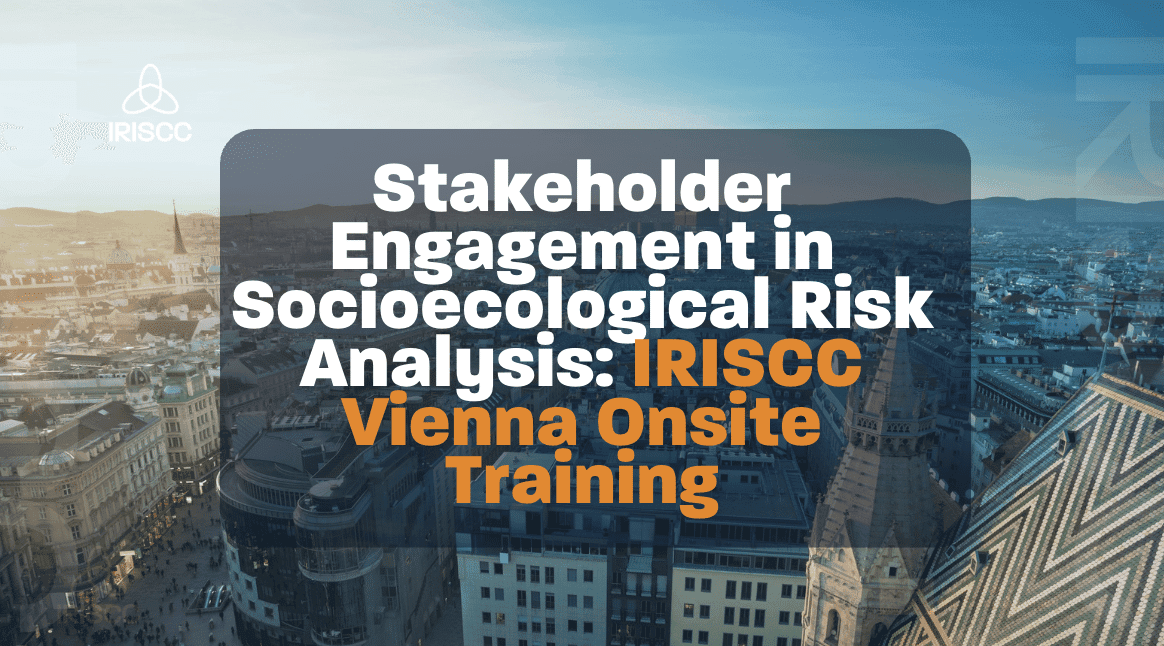
From June 24–26, 2026, IRISCC hosted an onsite training titled "Stakeholder Engagement in Socioecological Risk Analysis" at BOKU University in Vienna, Austria. Led by trainers Veronika Gaube (BOKU), Thomas Thaler (BOKU), and Nikolaos Nikolaidis (Technical University of Crete), the 2.5-day course provided participants with practical tools to analyze socio-ecological risks and collaborate effectively with local stakeholders.
Core Topics & Methodology
To bridge theory and real-world application, the training walked attendees through five core thematic modules:
- Social Ecology & Systems Thinking: Explored society-nature interactions, feedback loops, scale, and resilience. Participants examined three core knowledge types: Systems knowledge (current state), Target knowledge (desired future outcomes), and Transformation knowledge (pathways to change).
- Stakeholder Analysis & Mapping: Used practical tools like the Power-Interest Grid and Power-Predictability Matrix to group actors by influence, interest, and behavior, helping manage project risks.
- Participatory Modeling: Showed how agent-based models (ABM) and interactive workshops can structure stakeholder discussions and simulate how systems react to policy shifts.
- Empirical WEFE Nexus Applications: Reviewed regional case studies from the Jordan Valley and Crete. The group used Multi-Criteria Decision Analysis (MCDA) and Nature-Based Solutions (NBS) to weigh trade-offs across Water, Energy, Food, and Ecosystems.
- Action Planning & Exercises: Concluded with group exercises, role-playing, and draft engagement plans applied directly to the participants' own research projects.
Participant Profiles & Network Reach
Applying these methodologies to real case studies brought together an interdisciplinary group of researchers and specialists, yielding strong engagement across sectors:
- Demographics & External Reach: Nine participants attended from seven research institutions and two consulting firms, with 44% coming from organizations outside the IRISCC consortium.
- Research Infrastructure Ties: Over half of the participants (56%) were connected to the eLTER research infrastructure, strengthening cross-border collaboration in the Earth and environmental sciences.
- Target Systems & Focus Risks: Participants brought projects centered on agroecosystems (21%), rural communities (18%), grasslands (14%), and urban areas (14%). Primary risk domains included drought (23%), air/water pollution (15%), climate warming (15%), and desertification (12%).
- Interdisciplinary Expertise: Attendees brought a balanced mix of backgrounds, with 45% coming from social sciences and 33% combining natural and social science disciplines.
By connecting researchers across disciplines and external organizations, the training provided a practical framework for incorporating stakeholder engagement into ongoing risk analysis work.
Related content
IRISCC Demonstrators Progress Towards Second Service Release
The IRISCC demonstrators are advancing towards the second service release, planned for September 2026. This
June 03, 2026

Demonstrators
IRISCC Demonstrators are pilot projects that showcase the potential of combining data and expertise from

Services
IRISCC offers a comprehensive suite of services that integrate data, facilities, expertise, and advanced tools