Name: Samantha Gallatin
Institution: University of Tübingen
IRISCC installation: USRL / Cyprus Institute
Name: Samantha Gallatin
Institution: University of Tübingen
IRISCC installation: USRL / Cyprus Institute
Could you briefly describe your research and why you applied for access through IRISCC?
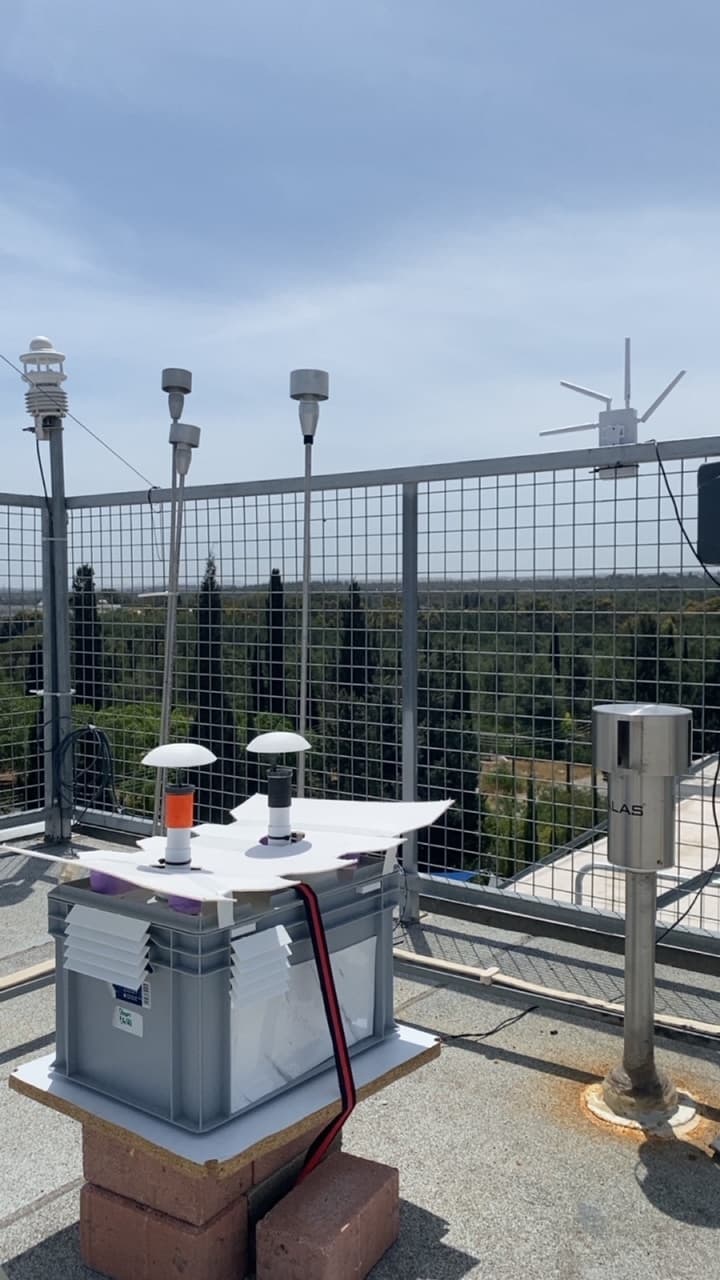
As a member of the Environmental Physics group of the University of Tübingen, I specialize in using uncrewed aircraft systems (UAS) to measure meteorological parameters and particularly focus on particle measurements. In 2022, my colleagues traveled to Orounda, Cyprus to observe Saharan dust and compare the measurements of an Alphasense OPC-N3 to a Palas Fidas and UCASS – another OPC-N3 located on a fixed winged aircraft of type Skywalker. To further verify the OPC-N3’s sampling, we traveled back to Nicosia, Cyprus, to compare our OPC-N3 measurements to that of a gravimetric device – a tapered element oscillating microbalance (TEOM) – located at the Cyprus Institute. As the Cyprus Institute is one of the facilities available for correspondence through the IRISCC, we selected this platform to apply to.
How did you experience the application and access process overall?
Overall, the application and access process was straightforward and easy to navigate. The procedure was simple to follow, and the categories and questions were clearly structured, which made the process efficient and accessible
Which IRISCC services, facilities, or expertise were most important for your research?
During our research campaign, we utilized the Cyprus Institute. We were offered a location to work, allowed to install our instruments near the reference, and also received ample aid and guidance from the team there. Ultimately, the most important aspect of this was the guidance and expertise offered by the team members who are specialized in using remote sensing devices and UAV to measure Saharan dust particles.
How did access to IRISCC affect the quality, scope, or feasibility of your research?
Without access to IRISCC, our research would not have been feasible, as we would not have been able to travel to Nicosia to conduct our experiment. Further, without the guidance of the Cyprus Institute, it is likely we would have crossed greater struggles that would have prolonged the publishing of our results and depreciated their quality and holistic insights.
What was the most valuable aspect of your experience?
Although there are numerous aspects that were valuable to our research campaign, the guidance and ability to network with the members of the Cyprus Institute were most valuable. Their knowledge and expertise were pivotal to our work.
Would you recommend IRISCC to other researchers, and why?
I would definitely recommend IRISCC to other researchers. It offers valuable opportunities for collaboration, networking, and access to specialized facilities and expertise. In our case, IRISCC helped facilitate scientific exchange and expand shared knowledge. Opportunities like these make scientific advances more achievable, especially when supported by an application process that is clear and accessible rather than overly complicated.